

The MarTech stack you actually need in 2026
Eleven thousand tools, most of them noise. Here's the small, AI-native stack we actually use to ship brand, web, and growth from one team — and what we ripped out.
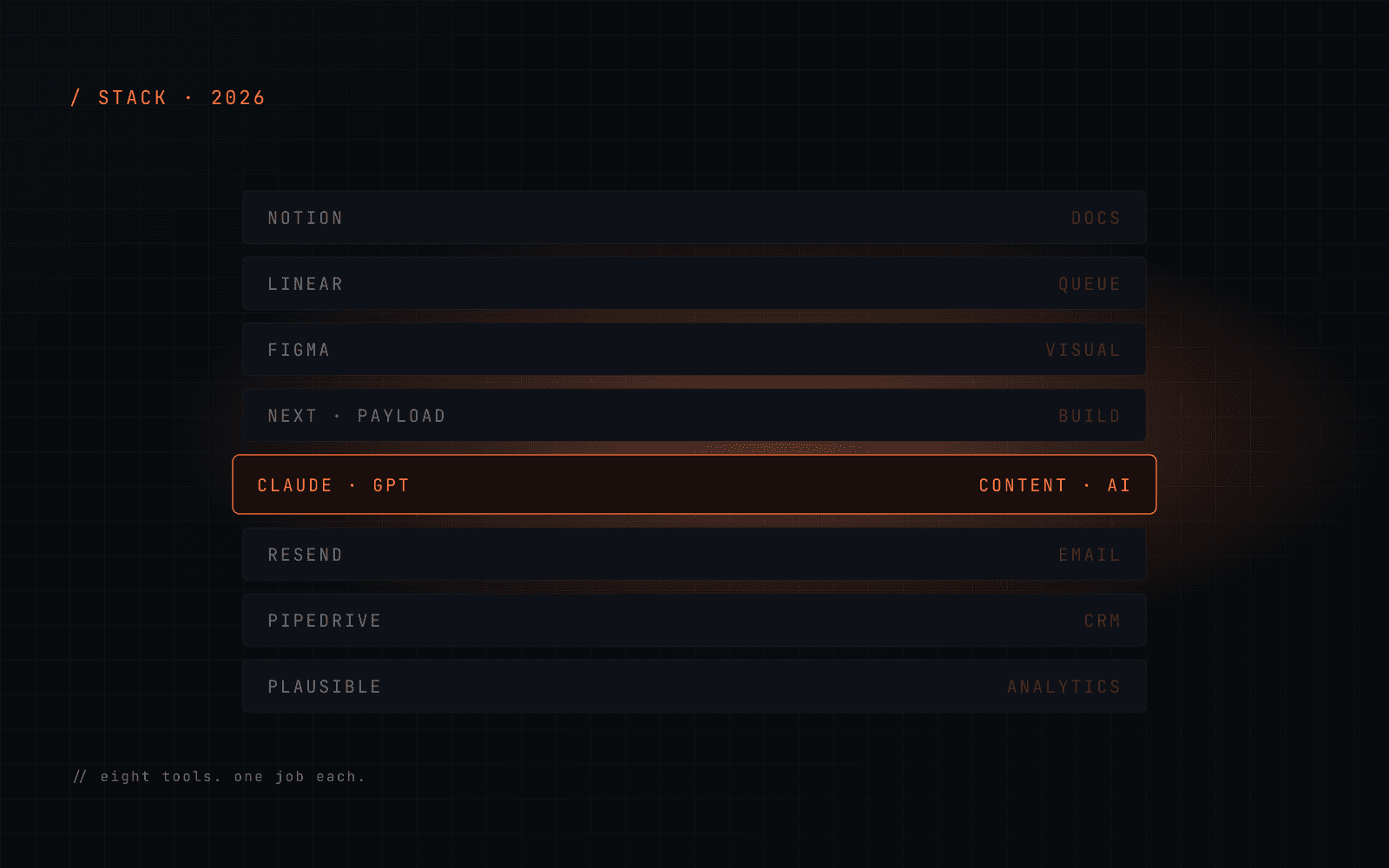
Eleven thousand martech tools were on the market last year. Most do the same thing the next one does, badly. A small team doesn't need them. We run brand, web, and growth on a stack you can count on one hand — and it works because every tool earns its place by doing a job the rest of the stack can't.
What stays
Strategy and ops: a doc and a queue. Notion for the work-in-progress; Linear for what's actually being shipped. That's it. We've tried fancier and gone back.
Design and build: Figma for the visual, Next.js + Payload for the actual site, Vercel for deploy. Five tools, one workflow. No marketing-page builder in between, no CMS we'll outgrow in a year.
Content and AI: Claude and GPT, called directly. We don't pay a wrapper to do prompt engineering for us. The prompts and the drafts live in Notion next to the brief, and a person makes the verdict on every piece before it ships.
Email and lifecycle: Resend for transactional and lifecycle (a small, honest API), one CRM — Pipedrive or HubSpot, pick — and Plausible for analytics that you'd actually pay for if it weren't included. Nothing else.
What we ripped out
A/B testing platforms nobody opens. AI content tools that wrap a twenty-dollar model in a two-hundred-dollar subscription. Point solutions for every funnel stage that don't talk to each other. A 'data warehouse' with three rows in it. The dashboard you built six months ago and never opened again.
A stack is a thesis
Most stacks are bloated because they were assembled by procurement, not by the people doing the work. A small senior team needs a small stack. The way you find out which tools earn their place is to take one out for a week and see if anyone notices.
Mostly, it should be three tools and a process. The rest is overhead with a login screen.